Enzyme Testing Supplier: Sample Screening, QC and Pilot Checks Before Bulk Supply
Source enzyme samples for R&D, lab screening, and pilot validation with COA/TDS/SDS, dosage guidance, QC checks, and cost-in-use support.
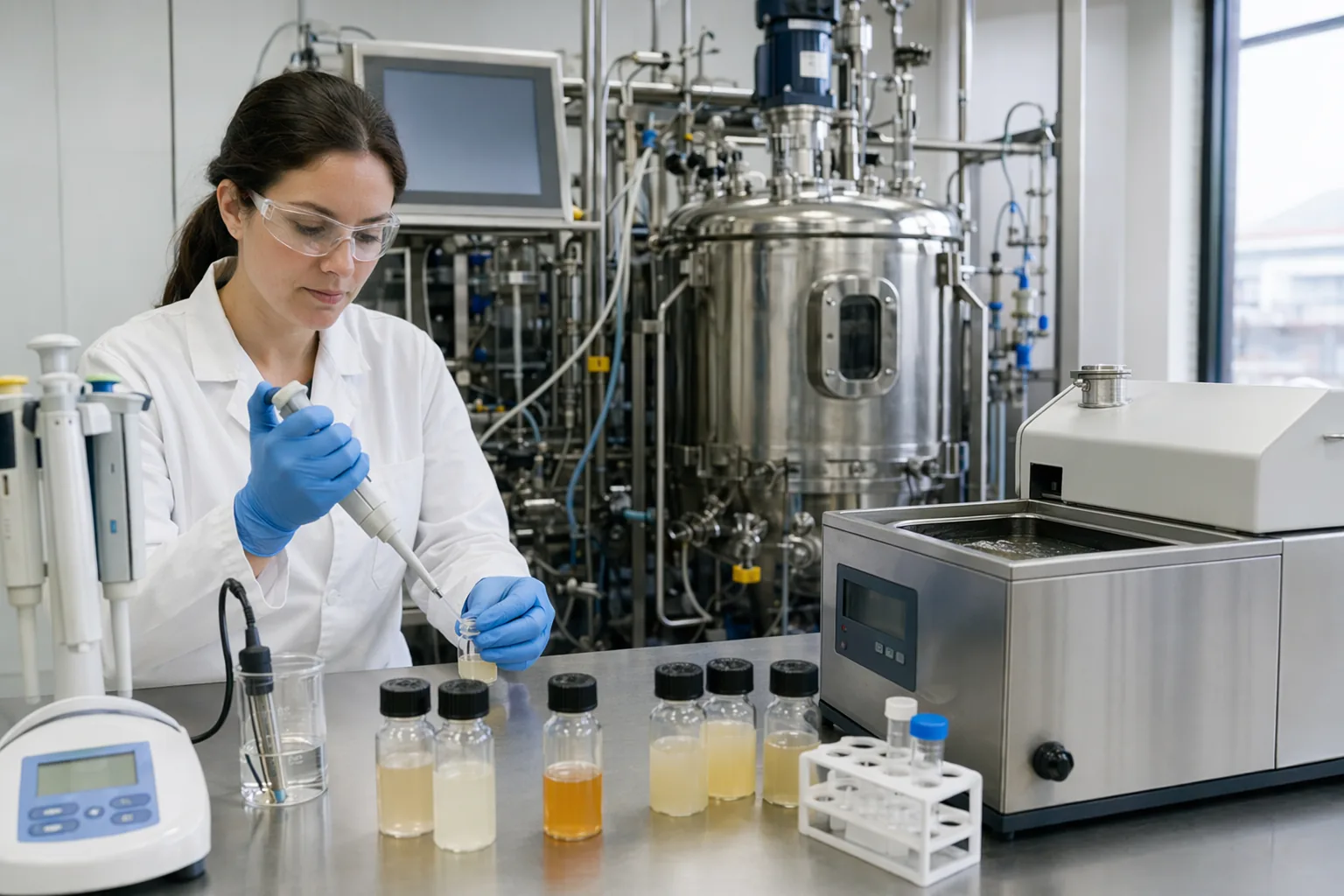
For formulators, manufacturers and resellers who must show that an enzyme works before they commit to bulk supply. This page covers how to test a supplier's sample, which quality checks to run on an incoming lot, and how to turn bench data into a purchasing decision.
Why Test Before You Commit to Bulk
Testing before buying protects production. Instead of ordering full drums too early, buyers screen supplier samples in their own application lab or pilot line, under their own conditions. This matters whether the enzyme is a protease, amylase, cellulase, lipase, pectinase, xylanase, lactase or alpha-galactosidase, and whether it goes into food processing, detergents, textiles, pulp and paper, feed, starch conversion, brewing or bioprocessing. The useful outcome is not a vial that 'works' once; it is a documented result your purchasing, QA and production teams can sign off together.
Screen in your own process conditions • Confirm at pilot scale • Reduce risk before bulk purchase • Align technical and procurement teams
How to Define Your Enzyme Trial
A clear trial begins with the substrate, target function and operating window. Use the pH and temperature range on the supplier's technical data sheet as the starting frame, then narrow it to your real process. Plan a dose ladder of low, medium and high points rather than one dose, because the right range depends on enzyme activity, substrate load, contact time and process economics. Agree acceptance criteria before the first run.
State substrate type and solids level • Define pH, temperature and contact time • Request low, medium and high dosage points • Confirm storage and dilution instructions
Documentation Buyers Should Request
Industrial enzyme testing depends on reliable documentation. Before lab work begins, request a certificate of analysis (COA), technical data sheet (TDS), safety data sheet (SDS), allergen or composition statement where relevant, and the activity assay method used by the producer. The COA should identify batch number, appearance, activity value, and basic release checks. The TDS should explain application range, pH and temperature stability, recommended dosage, storage, and compatibility warnings. The SDS supports safe handling, PPE selection, spill response, and transport review. For regulated or customer-sensitive applications, ask whether additional statements are available, but avoid assuming certifications that are not documented. A capable enzyme testing supplier for R&D will also clarify whether the sample is liquid, powder, granulate, or immobilized form and whether preservatives, carriers, salts, or stabilizers may affect the formulation.
COA for batch and activity confirmation • TDS for application and dosage guidance • SDS for safe handling review • Assay method for comparable activity data
Bench Screening and QC Checks
Bench testing should be designed to show both enzyme performance and formulation compatibility. Use a control with no enzyme, at least three dosage levels, and duplicate or triplicate runs when sample volume allows. Track pH drift, temperature profile, mixing time, viscosity, turbidity, soluble solids, reducing sugars, degree of hydrolysis, stain removal, fiber modification, or other application-specific markers. For many enzymes, activity may decline outside the recommended pH and temperature range, so include stability holds such as 30, 60, and 120 minutes when process residence time is important. QC checks should include appearance, odor, sediment, microbial limits where required, and activity retention after storage. This is the core of industrial enzyme testing R&D: translating a supplier sample into measurable process data rather than relying only on label activity.
Run controls and dose-response curves • Measure performance and side effects • Check activity retention after storage • Record all dilution and handling steps
Troubleshooting Poor Trial Results
A failed industrial enzyme trial order testing result does not always mean the enzyme is unsuitable. Low response can come from incorrect pH, excessive temperature, insufficient contact time, poor mixing, substrate variability, preservatives, oxidizers, surfactants, chelants, heavy metals, or residual cleaning chemicals. In solid or slurry systems, mass transfer can be as important as enzyme activity. If results are inconsistent, repeat the trial with a fresh sample, verified storage conditions, and a controlled blank. Include a heat-inactivated enzyme control when practical to separate enzymatic action from formulation effects. For industrial enzyme samples R&D, QC checks should include pH, temperature profile, substrate dry solids, viscosity or particle size where relevant, and final product quality metrics. These checks help technical teams identify whether the issue is chemistry, process control, or sample handling.
Use blanks and controls to isolate enzyme effect • Check for inhibitors such as oxidizers or residual cleaners • Repeat key trials with controlled sample storage
Incoming-Lot Checks: Alpha-Galactosidase Example
For alpha-galactosidase, check the incoming lot against the documents that came with your approved sample: activity in GalU/g and the method behind it, appearance (off-white to tan powder), the pH 4.0–6.5 and 40°C–55°C working range, and shelf life of 24 months sealed, cool and dry. Then repeat one short trial on your own legume, plant-protein or soybean-meal substrate at the approved dose. If the residual raffinose and stachyose result matches the approval trial, the lot is consistent with what you bought.
From Lab Result to Pilot Validation
Positive bench data should be confirmed at pilot scale before commercial commitment. Mixing energy, heat transfer, residence time, substrate variability, and downstream separation can change enzyme performance. An enzyme testing supplier for pilot scale should help convert lab dosage into pilot conditions, such as units per kilogram substrate, ppm preparation, or percentage by formulation weight. Pilot validation should confirm yield improvement, reaction endpoint, cleaning performance, filtration rate, viscosity reduction, texture, color, or by-product profile. It should also test process robustness at the practical edges of pH, temperature, and hold time. Industrial enzyme trial order testing is most valuable when procurement, production, QA, and R&D agree on pass/fail criteria before the run. This makes supplier qualification faster and avoids overvaluing a sample that performs only under ideal bench conditions.
Confirm scale-up dosage basis • Test realistic process variability • Document pass/fail criteria • Capture data for supplier qualification
Cost-in-Use and Supplier Qualification
The lowest sample price is rarely the best purchasing metric. Cost-in-use compares enzyme activity, dosage, yield effect, process time, waste reduction, handling cost, freight, shelf life, and batch consistency. Two enzymes with the same nominal activity can perform differently if the assay method, formulation stabilizers, or application conditions differ. During supplier qualification, evaluate response speed, documentation completeness, technical support, sample traceability, lead time, packaging options, and ability to support repeated trial orders. Buyers searching for an enzyme testing supplier for testing should also ask whether commercial lots can be matched to pilot samples and whether retain samples or batch trend data are available. A structured evaluation helps separate promising enzymes from unsuitable options before purchase orders become large and operational risk increases.
Compare cost per treated unit, not only price per kilogram • Check batch-to-batch consistency • Review lead time and packaging flexibility • Confirm commercial supply alignment
Technical Buying Checklist
Before you approve a supplier from test results: • No-enzyme control and current-process control run alongside every candidate. • Results normalized to the same activity basis and assay method. • Activity retention checked after storage at your site. • Inhibitors in your matrix (oxidizers, preservatives, residual cleaners) ruled out. • Pilot run confirms the bench dose. • Incoming-lot check defined for the first commercial delivery.
What to Include When You Ask for a Quote
After testing, send the approved product and activity grade, the quantity per order or per month, the pack size and the destination country, together with the test result you want each lot to match. Price and lead time are quoted per order.
Alpha-Galactosidase for Research & Industry
Need Alpha-Galactosidase for your lab or production process?
ISO 9001 certified · Food-grade & research-grade · Ships to 80+ countries
Frequently Asked Questions
What should come with an enzyme sample for testing?
COA, TDS, SDS, the activity method, recommended storage, and starting dosage guidance, so your R&D team can run structured, repeatable formulation tests and compare suppliers on the same basis.
How is an enzyme testing supplier for R&D different from a bulk distributor?
An enzyme testing supplier for R&D focuses on sample selection, application fit, documentation, and screening support before bulk procurement. A bulk distributor may be optimized for volume supply, while R&D testing requires smaller quantities, clearer technical guidance, batch traceability, and help defining pH, temperature, dosage, and QC checks for early-stage formulation work.
What does enzyme quality control cover on an incoming lot?
Appearance, odor, sediment, pH of solution, activity against the stated method, microbial limits where required, packaging integrity and the lot number on the COA. Then a short repeat of your approval trial confirms that the lot behaves like the sample you approved.
How should industrial enzyme testing R&D teams compare samples?
Industrial enzyme testing R&D teams should compare samples using the same substrate, pH, temperature, contact time, and dose-response design. Include a no-enzyme control and repeat key conditions. Review activity method, formulation type, stability, side effects, and cost-in-use. The best sample is the one that performs consistently under your process conditions, not just the one with the highest label activity.
Ready to source?
Request enzyme samples, COA/TDS/SDS, and trial guidance for your next R&D or pilot-scale formulation test. When the test passes, send the grade, quantity and destination for a bulk quote.
Contact Us to Contributehello@mail.enzymecollect.com